
client projects
My clients have included professors at UC Berkeley, UC San Diego, Harvard, Virginia Tech, the University of Oklahoma, Northwestern, Tulane, and Saint Louis University, Trinity College, and others. Projects I have collaborated on have been published with UC Press, Cambridge, Columbia University Press, University of Texas Press, and Princeton. Here are a few recent examples of my clients’ work. Let’s add your project to the list!
-

Based on over a decade of original archival research, this book shows how travelogues in Urdu gave voice to a global imagination that reflected the ambition and aspiration of Indians and Pakistanis as they negotiated their place in the changing world of the nineteenth century. In this interdisciplinary study, the author traces the social and literary history of the Urdu travelogue from 1840 to 1990 in six chronological chapters. Each chapter asks how travel writers used the genre to give meaning to the shifting social and political realities of their colonial and postcolonial world. Notably, the book highlights the role of women writers in the production of global imagination in Urdu and emphasises the role of the language in Asia and Africa.
-

Water for All chronicles how Bolivians democratized water access, focusing on the Cochabamba region, which is known for acute water scarcity and explosive water protests. Sarah T. Hines examines conflict and compromises over water from the 1870s to the 2010s, showing how communities of water users increased supply and extended distribution through collective labor and social struggle. Analyzing a wide variety of sources, from agrarian reform case records to oral history interviews, Hines investigates how water dispossession in the late nineteenth century and reclaimed water access in the twentieth and twenty-first centuries prompted, shaped, and strengthened popular and indigenous social movements. The struggle for democratic control over water culminated in the successful 2000 Water War, a decisive turning point for Bolivian politics.
Water for All was awarded LASA Environmental Section Best Book of 2022 by the Latin American Studies Association and earned an Honorable Mention for the Erminie Wheeler-Voegelin Book Award American Society for Ethnohistory in 2023.
-
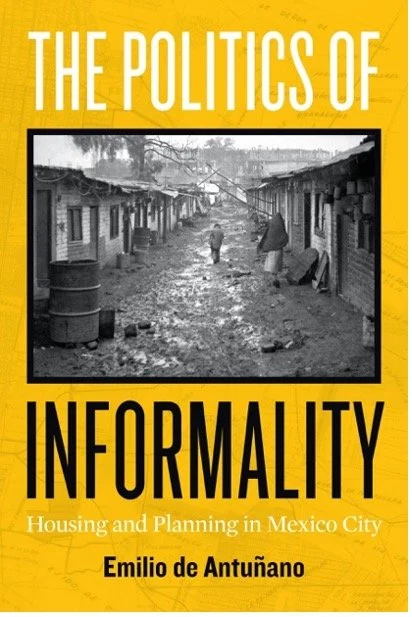
At the beginning of the twentieth century, Mexico City was tightly bounded, with a population of about half a million people. By the end of that century, it was an unfathomable megalopolis of some 20 million. The Politics of Informality is an illuminating political and intellectual history, examining how informal neighborhoods have figured in Mexican life and in the ideologies underlying urban planning. Prior to the Mexican Revolution of 1910, urban experts saw Mexico City as a tidy modern capital in-waiting. But during the interwar period, informal neighborhoods boomed, as working-class families asserted claims to housing under the revolution’s framework of citizenship and social justice. Then, amid Cold War realignments, a new cohort of urban experts pathologized Mexico City, turning it into a transnational laboratory for the study of poverty, migration, and overpopulation. Tracing a fascinating evolution, The Politics of Informality underscores the stubborn opposition between technocratic modernism and revolutionary, extralegal politics.
-
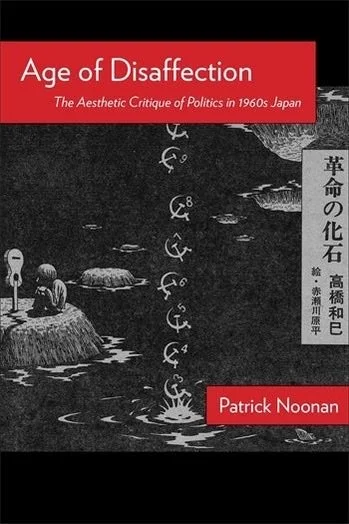
This provocative book uncovers a paradox at the heart of the 1960s in Japan: how political disillusionment became the basis for a new form of politics—a politics of the self. Examining aesthetic criticism, popular literature, avant-garde art, cinema, and political theory, Patrick Noonan argues that cultural producers in 1960s Japan cultivated what he calls an “ethos of disaffection” toward revolutionary politics and postwar society. Departing from approaches that define politics as contestation, Age of Disaffectionforegrounds cultivation, or the production of ways of feeling and relating to the world in efforts to redefine the political. It presents an unorthodox account of the 1960s: withdrawal from political activity developed not as the decade ended but as it was unfolding. Noonan reveals how Japanese artists and intellectuals in this period confronted a crucial question that continues to vex efforts at radical change today: transform institutions or alter how people relate to themselves and others?
Age of Disaffection won the Helen Tartar First Book Subvention Award from the American Comparative Literature Association in 2026.